Thursday, April 21, 2011

Blindisms- Are you guilty of these?

[This was my second speech for Toastmaster’s International. The objective was to organize my thoughts with a clear goal in mind. I talked about a topic that I have always wanted to share with people ever since I started working at the Braille Institute.]

A person with a badge with the letters V.I.P is standing next to me. A conversation occurs:

Me: Excuse me, I am trying to get to DeAnza Boulevard and Prospect Drive. Do you know where that is?

Other: Sure. Take this bus and get off at the third stop. Walk about 5 feet and take the bus at that stop. That should get you where you need to go.

Me: Thank you!

A similar conversation took place about five years ago. It wasn’t an unusual exchange as you saw. I asked for directions at a bus stop and was kindly given an answer. Instead, I want to bring the entire focus on the man that helped me. He is someone who one of my acquaintances would call a VIP; in other words, a ‘visually impaired person’. This acquaintance is herself blind so she uses this acronym in a light-hearted way.  

Today, I want to talk about a concept that is frequently discussed amongst VIPs called “blindisms”.“Blindisms” is a term coined by one of the instructors that I assist at the Braille Institute. These are ideas, perceptions, and mainly misconceptions that many of us sighted people might fall into. I want to focus on only two of these “blindisms” that the visually impaired community wants the rest of us to know. I talk about the following two specifically because they come up often in conversations amongst the students at the Braille Institute.

First, you can’t always tell whether someone is blind.  Although we might imagine a blind person to ‘look’ or ‘act’ a certain way, like carry a cane or perhaps have their eyes look ‘different’, there will be many VIPs that do not fit into that mold. As an example, although a white cane can be an identifier for us to know if someone is blind, not every VIP feels comfortable carrying one. I met an elderly lady who lost her sight due to glaucoma and macular degeneration and because she was an independent woman all her life, she said it was hard for her to rely on a cane. She refused to use one and thus, most people would not know just by looking at her that she is actually blind.

Secondly, visual impairment is not only limited to complete blindness. In fact, only about 10 percent of all blindness is one that causes its recipient to be in ‘complete darkness’. The rest either have only light perception, or their central vision is intact and they see nothing in the periphery.  For example, I met someone who said that people at the grocery store wouldn’t believe her when she said she was legally blind because she was previously seen reading (or trying to read) some signs (though she had to stand touching her nose to the sign to figure out what it said). So, you might have some vision, but this certainly does not mean that it is any easier to complete daily tasks in a sighted world.

Like I said earlier, there are many “blindisms”, but I presented you with the two most common. The reason I talked about these was the frequency with which they occur and with the hope that by sharing  them, I inspired us all to recognize the diversity that exists in the VIP world.

[The speech was very good, according to my evaluator, but the conclusion was too abrupt. I felt that I stumbled many times, but apparently no one noticed.]

Thursday, April 7, 2011

Reaching Milestones, One Rock at a Time

[I wrote the following for my first Toastmaster speech. It was supposed to be an ice-breaker speech, where I talk about myself in any way that I wanted to.]

Imagine this: You are holding onto a 20-foot wall with all your might. You haven’t reached the top of that wall yet, but you anxiously look down at the distance between you and the ground. You have your harness wrapped tightly around your body. One end of a rope is securely fastened to your harness while your partner holds on to the other end on the ground. Your face is sweaty, your palms are cracked, and your legs are sore.

That was me on my fifth attempt to reach the top of a wall during one of my very first rock-climbing classes. On my previous attempts, I would get nervous and come down after getting about half way to the top. This time was a little different. One of the class instructors decided that he would be the one holding my rope at the other end. Before I started climbing, he said to me very seriously, “You’re going to the top.”

So, I started climbing thinking that I will be down after another failed attempt. However, the instructor had a different plan in mind. He decided to keep me up there until I reached the top. He kept saying, “I’m not letting you down until you reach that bell.”  There was a bell at the top and I kept staring at it, desperately wanting to reach it. After about an hour or so, I made it to the top.

The reason I talk about this event is because it was a milestone in my life. I told myself, “After this, I can do anything.” Two years later, I decided to take it one step higher. Last summer, I went bungee jumping with my friends. Though I waited till the end to attempt that 100-foot jump, I still did it. Whenever I am faced with a new challenge, I tell myself “You climbed that wall. You jumped off that bridge. You got this!” These experiences summarize my passion for trying new things and the more scary they are, the more satisfied I am after having accomplished them.

[The speech went well, except that I had too many “Uhm’s” and “Ah’s” and I tended to clasp my hands together too much.]

Wednesday, March 30, 2011

I’m Linkin’ it: Gawaahi.com

gawaahi_2

 Gawaahi.com is a new website aimed at bringing testimonials of every day Pakistanis to the rest of the world. Whether it’s the survivors of last year’s devastating flood, minorities being oppressed, or a Pakistani celebrating her heritage, the website brings it to you via videos, pictures, interviews, articles, etc.

It’s refreshing to see the perspective of those that are actually affected by the events we hear about in the news. “Official” stories do not give us a real insight because it’s not personal. Through Gawaahi.com, Naveen Naqvi, Nofil Naqvi, and Sana Saleem (founders) bring stories of everyday Pakistanis to you through digital media. These are stories that celebrate and educate. I think it’s a great initiative and I hope to contribute something to this project myself.

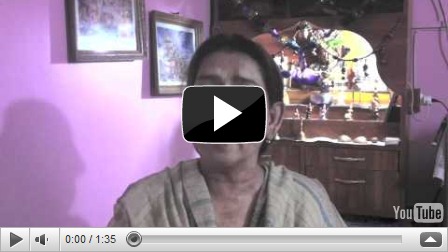
Here’s a video found on Gawaahi.com about a woman named Mangla Sharma. She is the Chairperson for the Pak-Hindu Welfare Council. She talks about protecting the Hindu temples that already exist in Pakistan, as there is a law that prohibits the enacting of new ones.

Friday, February 25, 2011

Stylish Blogger Award

The Rukhpar Mor blog received the ‘Stylish Blogger Award’ from Zarina Hassem, who blogs at ‘Muslim Women Exposed’. Sister Zarina is a counselor with an M.S. in Psychology and resides in Johannesburg, South Africa. She has authored a book titled ‘7 Things to Talk About’, which deals with important issues about Islam and encourages Muslims to reflect upon these.

JazakAllah Khayr (meaning: May God grant you goodness) for the award Sister!


image

Wednesday, January 12, 2011

Talat Farooq: The Voice of Pakistan

Guest post by J. Jacobs

J. Jacobs is a guest blogger for An Apple a Day and a writer on online nursing classes for the Guide to Health Education.


Talat Farooq is nothing short of extraordinary. Anyone trying to fill her shoes will have to find multiple pairs of feet, as Farooq serves as a poet, educator, human rights activist, student, columnist, and the executive editor of the Islamabad-based Criterion Quarterly. Recently, Farooq has taken up study at the University of Leicester United Kingdom, specializing in American policy towards Pakistan after the September 11th disaster. Although international affairs remain important to her, Farooq also focuses on what goes on in households behind closed doors. Farooq strives to communicate to the world about the struggles of women (Pakistani women, in particular) through her enticing poetry. Her work highlights how difficult it is for women to exercise control in a world run by men, especially in countries where women have continued to be cast aside. Through her colorful writing, Farooq helps the reader to understand the powerlessness and emptiness felt by many females across the world. One of the ways Farooq carries this out is by writing of instances of domestic violence.

Farooq has written two books of poetry, but her second book, Scheherzade, focuses largely on the many forms of abuse carried out against her beloved people. The National Language Authority (NLA) and the literary organization in Sherzad, Islamabad, came together to launch this powerful piece of literature, which has been spoken highly of by NLA chairman, Iftikhar Arif and Urdu poet and activist, Kishwar Naheed. Scheherzade incorporates the political sphere, as one cannot avoid it living as a female in Pakistan. Farooq's poems touch on certain areas of democracy and memorable events, such as the 2008 Pakistani elections, the assassination of former Prime Minister to Pakistan, Benazir Bhutto, and former President Bush's visit to Pakistan. If you seek to learn about women's empowerment, Scheherzade is a necessary read.

Personally, I honor Farooq for speaking out about some issues that frequently go ignored. Because domestic violence occurs in the private sector, many people believe that it shouldn't be brought to the forefront. Too many have been misguided to think that what happens at home should stay among the family. However, if what happens at home results in bruises, lacerations, tear-stained cheeks, or any other destruction to a human body or soul, something must be done to prevent it and/or to ensure that retribution comes to the perpetrator. I'd like to give my personal thanks to Talat Farooq for bringing this issue to the masses. As of now, certain legal blockades exist that prevent us from fully addressing domestic violence in certain parts of the world, but that doesn't mean we can't speak out against these atrocities, thus granting voices to all those who have been abused.

Additionally, abuse does not only come in the form of five fingers. Farooq's writing teaches her readers about the countless social injustices experienced by Pakistanis. Lastly, although women are often the targets, I respect Farooq for recognizing that both males and females are victims of injustices. If we are to move forward, we cannot place the blame on an entire gender, but we must work to end the cause of suffering of all sorts.

Related Posts Plugin for WordPress, Blogger...